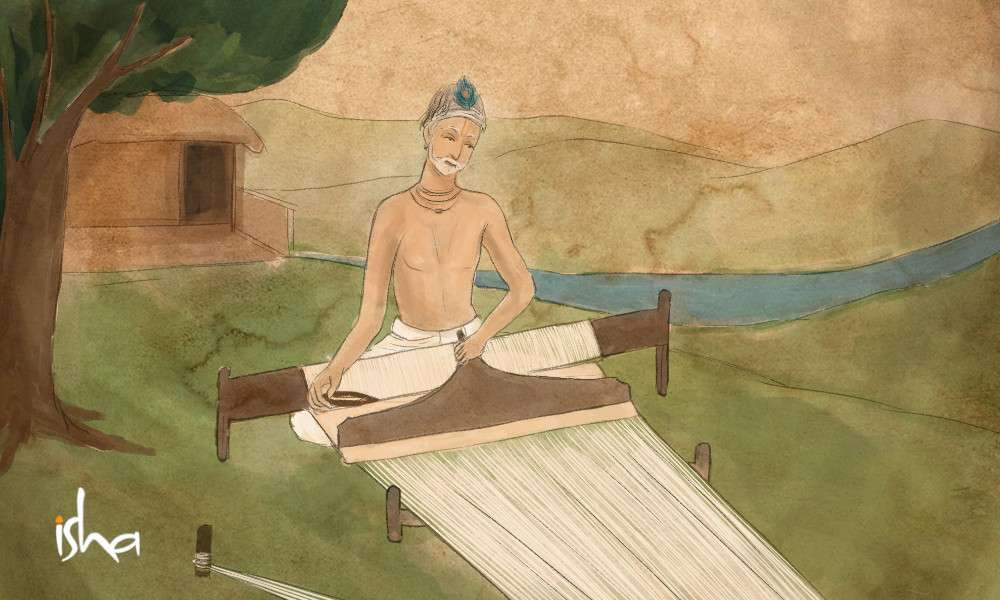
Transcending the Boundaries of Being
Kabir's profound assertion, "Beyond limits and the limitless is He, the pure Being," invites us to contemplate the nature of existence itself. In this statement, he beckons us to look beyond the confines of our ordinary perceptions, suggesting that true essence lies in a realm that transcends both limitation and infinity. This exploration is not merely philosophical; it is a call to experience the divine presence that permeates all aspects of life, urging us to seek a deeper understanding of our own being and the universe.
As we delve into Kabir's words, we encounter a rich tapestry of meaning that resonates with the core of human experience. The dichotomy of limits and the limitless speaks to our struggles with identity, purpose, and the search for fulfillment. In a world often defined by boundaries—be they physical, emotional, or spiritual—Kabir's invitation to recognize the pure Being beyond these confines serves as a reminder of the expansive nature of existence. This exploration of transcendence is not just an abstract idea; it is a vital aspect of our spiritual journey, urging us to embrace the fullness of life.
The image / the metaphor
The imagery in Kabir's quote is striking, as it juxtaposes the concepts of limits and the limitless, creating a dynamic interplay between two seemingly opposing states. The phrase "pure Being" evokes a sense of clarity and essence, suggesting a state of existence that is untainted by the complexities and distractions of the material world. The verbs chosen—"beyond" and "is"—imply a movement towards understanding that is both active and passive, inviting us to engage with the divine while also recognizing its inherent presence within us.
Diving deeper into the metaphor, we can see that Kabir is not merely discussing a distant or abstract deity; he is pointing to an intimate reality that exists within and around us. The "pure Being" can be understood as the ultimate truth that transcends all dualities, a state of consciousness that is both the source and the culmination of our spiritual pursuits. This notion of purity is essential, as it invites us to strip away the layers of ego and illusion that cloud our perception, allowing us to connect with the essence of existence itself.
In the speaker's tradition
Kabir's teachings are deeply rooted in the bhakti tradition, which emphasizes a personal and devotional relationship with the divine. This tradition often speaks of concepts such as dharma, the moral order of the universe, and kenosis, the self-emptying that allows for divine presence to fill our lives. In this context, the idea of "pure Being" aligns with the notion of sunyata, or emptiness, found in Buddhist thought, where the realization of emptiness leads to a profound understanding of interconnectedness and the nature of reality.
Furthermore, Kabir's emphasis on transcending limits resonates with the concept of fana in Sufi mysticism, which refers to the annihilation of the self in the presence of the divine. This transformative experience is echoed in the writings of other bhakti poets, such as Mirabai and Tulsidas, who similarly sought to dissolve the boundaries of individual identity in their quest for union with the divine. The "pure Being" that Kabir speaks of can thus be seen as the ultimate goal of these spiritual traditions, where the seeker merges with the source of all existence.
Living the teaching
In our modern lives, the teaching of Kabir can manifest in various ways, particularly in moments of stress or limitation. For instance, consider a situation where one feels overwhelmed by the demands of work or personal responsibilities. In such moments, the reminder of "pure Being" can serve as a grounding force, encouraging individuals to step back from their immediate concerns and reconnect with their deeper essence. This practice of mindfulness allows us to transcend the limits of our circumstances, fostering a sense of peace and clarity amidst chaos.
Moreover, this teaching can also be applied in relationships, especially during conflicts or misunderstandings. When faced with tension, remembering that we are all expressions of the same "pure Being" can shift our perspective, inviting compassion and understanding. By recognizing the shared essence in ourselves and others, we can navigate difficult moments with grace, fostering deeper connections and healing. This practice of seeing beyond the limits of our individual experiences opens the door to a more profound sense of unity and love.
A reflection
As we contemplate Kabir's words, we are invited to reflect on our own understanding of existence and the divine. What does it mean for you to recognize the "pure Being" that lies beyond the limits of your everyday life? In what ways can you cultivate a deeper awareness of this essence within yourself and in your interactions with others? These questions serve as a guide for our spiritual journey, encouraging us to explore the vastness of our being and the interconnectedness of all life.



Join the BrightStar Community
Stay connected with daily inspiration, event announcements, and community wisdom