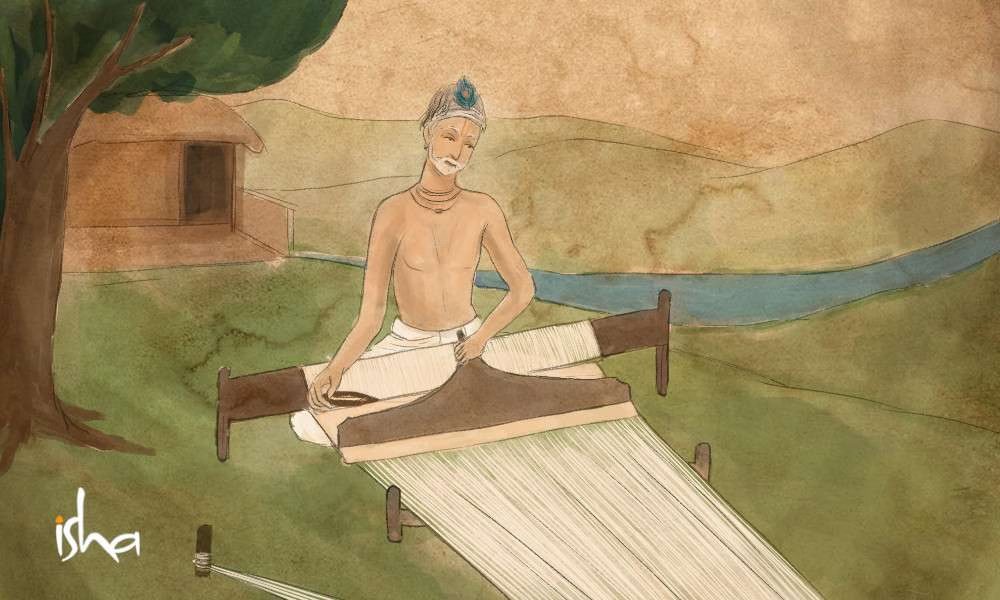
Unity Beyond Boundaries: The Wisdom of Kabir
In the profound words of Kabir, "Kabir is the child of Allah and of Ram: He is my Guru, He is my Pir," we encounter a striking declaration of spiritual identity that transcends the boundaries of religion. Here, Kabir positions himself as a child of both the Islamic and Hindu traditions, embodying a unity that challenges the divisive nature of sectarianism. This assertion is not merely a personal proclamation; it is an invitation to recognize the interconnectedness of all spiritual paths, urging us to embrace a more inclusive understanding of divinity.
At the heart of this quote lies a deep reverence for the divine, expressed through the duality of Allah and Ram, two figures that represent the essence of two major faiths. Kabir’s assertion that both are his guides—his Guru and Pir—invites us to reflect on the nature of spiritual authority and the ways in which wisdom can emerge from diverse traditions. This perspective is crucial in a world often marked by division, as it encourages a dialogue that honors the richness of different beliefs while recognizing the shared human quest for truth.
The image / the metaphor
In this quote, Kabir employs a powerful metaphor of parentage to convey his spiritual lineage. By referring to himself as the "child" of both Allah and Ram, he evokes a sense of belonging that is both personal and universal. The choice of the word "child" suggests innocence, openness, and a direct connection to the divine, while the figures of Allah and Ram symbolize the vastness of spiritual wisdom across cultures. This imagery invites us to consider our own spiritual heritage and the ways in which we might draw from multiple sources of inspiration.
Diving deeper into the metaphor, we find that Kabir’s identity as a child of both traditions speaks to the idea of spiritual synthesis. It challenges us to move beyond the confines of dogma and to embrace a more expansive view of spirituality. This synthesis is not merely an intellectual exercise; it is a lived experience that calls for humility, compassion, and a willingness to learn from others. In this way, Kabir’s words resonate with the essence of bhakti, which emphasizes love and devotion as pathways to the divine, transcending the limitations imposed by religious labels.
In the speaker's tradition
Kabir’s assertion is deeply rooted in the bhakti tradition, which emphasizes personal devotion and the direct experience of the divine. This tradition is characterized by its rejection of ritualistic practices and its focus on the inner journey toward union with God. Concepts such as dharma and bhakti are central to understanding Kabir's perspective, as they highlight the importance of living a life aligned with one's true purpose while cultivating a loving relationship with the divine. In this context, the idea of kenosis—self-emptying for the sake of love—also resonates, as Kabir invites us to let go of our ego and embrace a more profound connection with the divine.
Moreover, Kabir’s teachings can be compared to those found in the works of other mystics, such as Rumi or Mirabai, who similarly sought to bridge the gaps between different spiritual paths. In the poetry of Rumi, for instance, we find a similar celebration of unity, where the beloved transcends all distinctions. This shared vision of oneness invites us to explore the depths of our own spiritual practices and to recognize the divine presence in all aspects of life, regardless of the labels we may attach to them.
Living the teaching
To bring Kabir’s teaching into our modern lives, consider a scenario where one encounters a person from a different faith tradition. In a moment of tension or misunderstanding, Kabir’s words can serve as a reminder to seek common ground rather than focusing on differences. By recognizing the shared humanity and the divine essence within each individual, we can foster a spirit of compassion and understanding that transcends religious divides. This practice not only enriches our relationships but also deepens our own spiritual journey.
Another application of this teaching might arise in the context of personal relationships. Imagine navigating a conflict with a loved one, where differing beliefs or values create friction. In such moments, invoking Kabir’s perspective can encourage us to approach the situation with empathy and openness. By acknowledging that both parties may draw from different spiritual wells, we can cultivate a dialogue that honors each person’s journey while seeking a harmonious resolution. This practice of reverence and unity can transform our interactions, allowing love to flourish amidst diversity.
A reflection
As we contemplate Kabir’s profound declaration, we are invited to reflect on our own spiritual identities and the ways in which we relate to others. How might we embody the spirit of unity that Kabir exemplifies in our daily lives? In what ways can we honor the diverse paths that lead to the same divine source? These questions encourage us to explore the depths of our connections with others and to embrace the richness of our shared humanity.




Join the BrightStar Community
Stay connected with daily inspiration, event announcements, and community wisdom