What is "Just a Glance" in the Kirtan Tradition?
"Just a Glance" is a devotional kirtan performance by Simrit, a vocalist and harmonium player rooted in Sikh spiritual music. The piece represents the living practice of call-and-response sacred music, where the singer invokes divine presence through repetitive vocal phrases, melodic structures, and collective resonance. Unlike recorded studio versions, this live performance captures the real-time interaction between vocalist, ensemble, and audience—an essential element of kirtan as communal spiritual practice.
Kirtan itself is not performance art in the Western sense; it is a participatory devotional form where the boundary between musician and listener dissolves. The repetition of sacred phrases, often drawn from Sikh scripture and Hindu bhakti tradition, creates a meditative container for those present. In this live rendering, Simrit's vocal phrasing and the ensemble's instrumental support work to establish and deepen that meditative state.
How Does the Ensemble Support the Devotional Container?
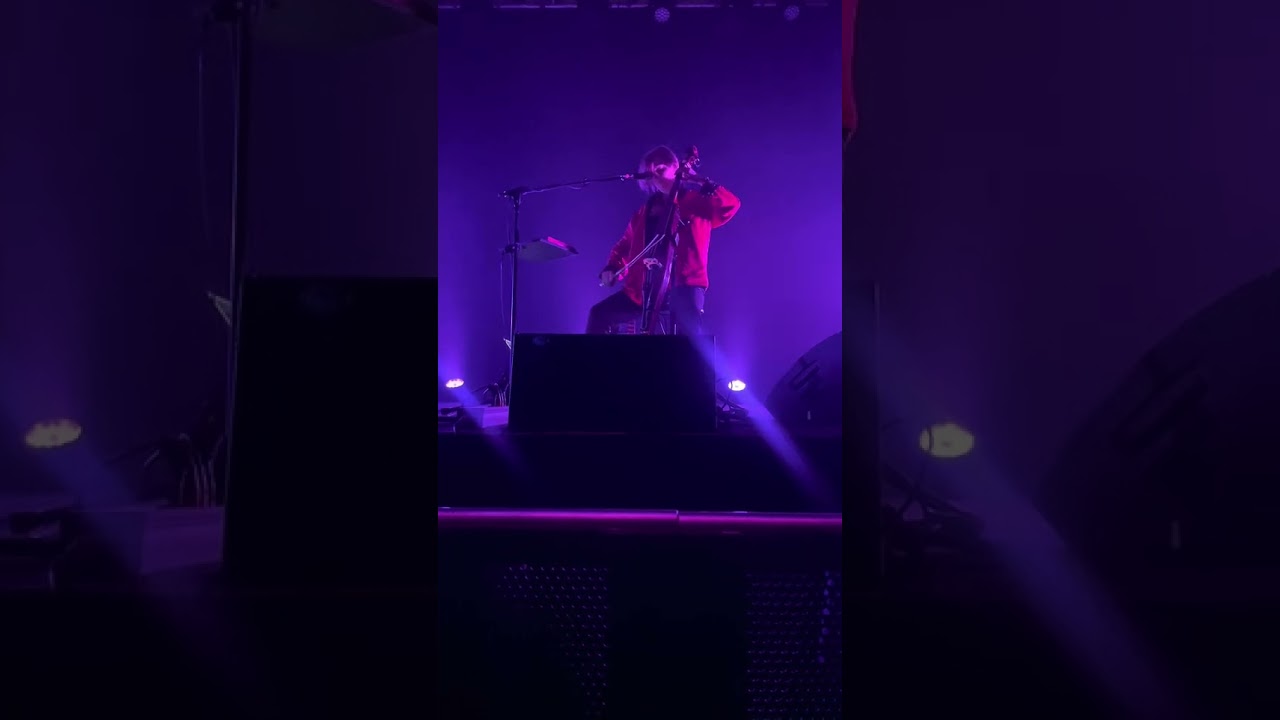
The arrangement of "Just a Glance" features a carefully considered instrumental lineup: Simrit on vocals and harmonium, Salif Bamakora on kora (West African string instrument), Shannon Hayden on cello and guitar with vocal harmony, Jared May on bass and vocals, and Devon Ashley on drums and percussion. This combination is neither traditional Indian nor purely Western; it represents a contemporary approach to kirtan that honors the tradition while embracing global musical language.
The harmonium, central to North Indian classical and kirtan music, provides the harmonic foundation and melodic scaffolding that guides the vocal line. The kora—with its bright, ethereal quality—adds textural complexity without competing with the voice, creating space for the devotional content to emerge. The cello grounds the arrangement with warmth and depth, while the rhythm section (bass and drums) provides a steady temporal container that allows listeners to settle into meditative awareness. Shannon Hayden's vocal harmonies create calls and echoes that mirror the call-and-response structure of kirtan itself, inviting the audience into the singing.
What Role Does Repetition Play in Sacred Singing?
The structure of "Just a Glance" relies on repetitive melodic and lyrical phrases. In the kirtan tradition, this repetition is not mere musical technique—it is a tool for consciousness transformation. The Nada Brahma principle (the idea that sound/vibration is the fundamental reality) underlies this practice. As a phrase is repeated, the mind gradually releases its commentary and judgment, and the body begins to entrain to the vocal frequency and rhythm. This is not a metaphorical process; neuroscience increasingly shows that rhythmic sound induces measurable changes in brain state and nervous system regulation.
Simrit's vocal phrasing in this live performance demonstrates a key principle: the glance itself—the moment of recognition, of being seen by the divine—cannot be described or analyzed. Instead, it is evoked through the quality of the voice, the breath support, the slight variations in timing and pitch that give the repetition aliveness rather than mechanical quality. The live context amplifies this: when a room full of people are singing or listening together, the collective resonance strengthens the meditative field.
How Does Live Performance Differ from Studio Recordings?
While Simrit has released studio recordings of her work, the live performance captured here carries distinct qualities. In the studio, the focus is on technical perfection, layered harmonies, and sonic clarity. In a live kirtan setting, the focus shifts: there is no do-over, no editing. The musicians must remain present to one another and to the audience. The acoustic properties of the room become part of the music. Most importantly, the energy exchange between performer and listener is direct and unmediated.
You can hear this in the audience responses—applause at key moments, audible engagement. This is not incidental; it is the completion of the circuit. The musicians offer the devotional container, the listeners receive and participate, and that collective intention shapes what emerges musically. A studio recording is a fixed artifact; a live kirtan is a temporary but vivid shared reality.
What Sonic Elements Create the Meditative Quality?
Several technical and musical choices contribute to the meditative texture of this performance. First, the overall dynamic range—while there are moments of fuller sound, the ensemble does not overwhelm. Voices remain audible. The tempo is moderate, allowing breath and settlement. The harmonic language is consonant and resolved, not dissonant or unresolved, which the nervous system registers as stable rather than destabilized.
The use of drone instruments (the harmonium provides both harmonic and drone functions) anchors the listener in a single frequency center, preventing mental wandering in the way that shifting key centers might. The cello and kora add movement and color around that anchor, like clouds moving across a still mountain. This balance between stillness and motion, repetition and variation, is the hallmark of effective meditative music.
Where Does the Title "Just a Glance" Come From?
While the full lyrical content is not transcribed clearly in the available record, the title "Just a Glance" suggests a theme drawn from bhakti philosophy—the idea that a moment of divine recognition requires no elaboration, no proof, no argument. It is immediate and direct, like a glance. In Sufi and Hindu mystical poetry, the gaze of the beloved (the divine) is described as sufficient for transformation. You do not need to understand it intellectually; the glance itself is the teaching.
This is reflected in the simplicity and power of the musical language Simrit employs. Complex virtuosity would undermine the message; instead, the focus remains on clarity, presence, and the quality of offering.
How Is This Piece Situated in Contemporary Kirtan Music?
Simrit's work represents a significant strand in contemporary kirtan—one that honors the Sikh and Hindu devotional roots while being openly contemporary and global. The inclusion of instruments like the kora and cello, and the visible diversity of the ensemble, reflects the reality that kirtan is no longer (if it ever was) confined to a single ethnic or religious identity. The practice is being taken up by musicians and devotees from many backgrounds, and Simrit's approach acknowledges this without diluting the depth of the tradition.
The professionalism of the recording and filming (credits include Oz Fritz on live sound, Akhi Lavoie on cinematography and editing, and Paul Mahan on mixing and mastering) also situates this as a contemporary sacred music project, not a purely community or informal practice. This raises an interesting question: can a professionally recorded, released, and distributed kirtan performance maintain its meditative and devotional integrity? Simrit's work suggests the answer is yes—if the musicians themselves are grounded in the practice, the professionalism serves the dharma rather than replacing it.
Where to go from here
To deepen engagement with "Just a Glance," listen to the studio album version available through Simrit's digital channels to compare the live and recorded versions. Seek out other kirtan musicians—both traditional and contemporary—to understand the breadth of the form. Consider attending a live kirtan if accessible, as the communal aspect cannot be fully conveyed through video or audio alone. Study the Sikh Gurus' teachings or the bhakti poetry that informs this music to understand the philosophical grounding. Finally, if drawn to the practice, experiment with repeating a simple phrase or mantra in your own voice to experience directly how sound, breath, and attention interact to shift consciousness.